Showing posts with label American West. Show all posts

Monday, May 16, 2016

Epilogue to an Era

By 1840 the beaver trade was done.  A conversation with a trapper in 1846 shows that some held out hope years later..."Beaver's bound to rise.  Human nature can't go on selling beaver a dollar a pound.  That ain't a going to shine much longer.  There was times six dollars a skin." 

Most trappers had moved on to other things by 1846.  Some took to writing such as James Beckwourth   Much of what was written by the former trappers were tales spun to excite readers with a bit of fact woven in, but it did add new weight to the growing legend of the American West as the home of heroes.

Other former trappers became hunters for trading posts - decimating the buffalo herds for carriage robes, coats, rugs and shoe lining.  A good number of trappers left the mountains all together, moving on to the West Coast where they tried their hand at ranching.

Jim Bridger, Tom Fitzpatrick, Joseph Walker and Kit Carson went on to play major dramatic roles in taming the West.  Bridger built a trading post on the Oregon Trail in SW Wyoming.  Settlers stopped at Bridger's Fort for decades to learn route information and gather supplies.  Fitzpatrick and Walker became wilderness guides of legend.  Carson is remembered simply as the "pathfinder's pathfinder."
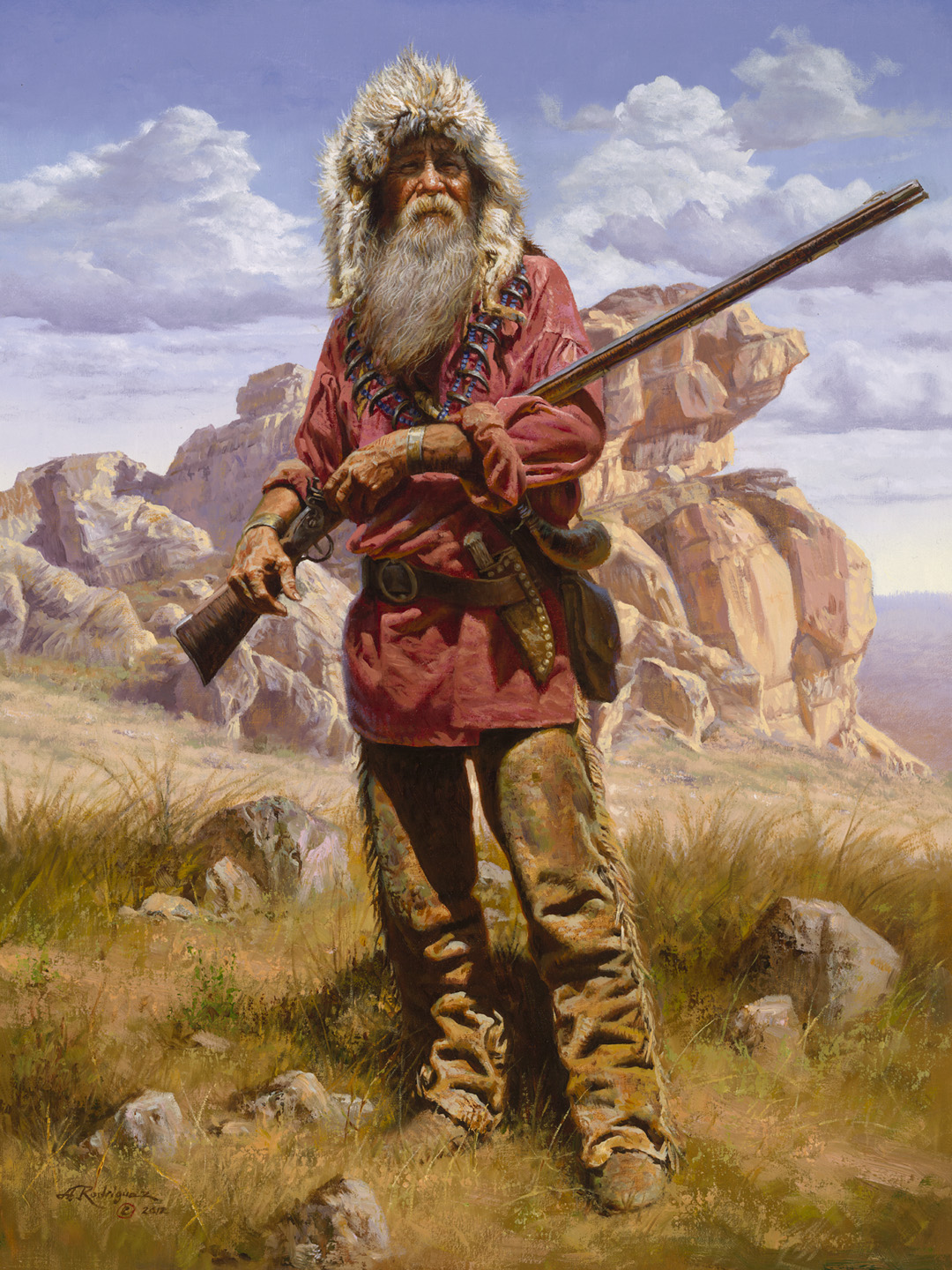
To sum up the life of the trapper best, Washington Irving wrote:

"No toil, no danger, no privation can turn him from his pursuit.  His passionate excitement at times resembles a mania.  In vain may cruel savages bisect his path, in vain the rocks may oppose his progress but let a single track of beaver meet his eye and he forgets all dangers.  At times he may be found scaling the most frightful precipices, searching for springs and lakes unknown to his comrades, where he may meet with his favorite game.  Such is the mountaineer, the hardy trapper of the West, and such is the wild, Robin Hood kind of life now existing among the Rocky Mountains." 

Next time - Inside Bent's Fort


_________________________
Today in Pioneer History: "On May 16, 1881, Dick Fellows, an inept horseman but persistent outlaw, becomes a free man after spending five years in the San Quentin prison.

Thursday, May 12, 2016

Artist on the Frontier

In June of 1837 in Green River Valley in Wyoming territory, over a 100 trappers gathered for the 13th annual trading rendezvous, one long festival which legend says was a "mountain man's Christmas, county fair, harvest festival and carnival" all rolled into one.  (Mardi Gras in New Orleans?)

Among those attending that year were a Scot aristocrat, William Drummond Stewart. Stewart, a veteran of Waterloo, spent four summers hunting in the Rockies, and spent his winters in New Orleans where he traded in cotton.  History says that he brought his favorite trapper, Jim Bridger, a gift that year all the way from Scotland - a suit of armor which Bridger put on and rode around the rendezvous.  This incident is recorded in a painting by our next attendee...

Also in attendance was the man who painted that strange incident, Alfred Jacob Miller.  Stewart hired
Miller in New Orleans for the specific purpose of accompanying him to the west that year, making a permanent record of the expedition for his castle back in Scotland.  Miller was constantly sketching, painting and taking notes.  He painted Indian trappers, business traders, and the party spirit that gives us a colorful picture of this period in history.

Miller writes "At certain specific times there is a 'Rendezvous' for trading with Indians and trappers.  Here they congregate from all quarters.  The first day is devoted to 'High Jinks' in which feasting, drinking, and gambling form the prominent parts.  Sometime a man becomes so excited with 'Fire Water' that he runs amok - is pursued and secured.  Affairs of Honor are adjusted between rival trappers, one of course receiving a complete drubbing, all caused evidently from mixing too much alcohol with their water.  Night closes this scene of revelry and confusion.  The following days exhibit the strongest contrast.  The buyer's tent is raised, the Indians erect their white lodges.  The accumulated furs are brought forth and buyers are besieged and busy.  Now the women come for their share of the ornaments and finery."

Next time...Epilogue to an Era

___________________________
Today in Pioneer History: "On May 12, 1832, the fur trader William Sublette leads a pack train out of Independence, Missouri, heading west for a disastrous rendezvous at Pierre’s Hole, Idaho where he was wounded by Indians.

Thursday, December 10, 2015

What's Out There?

For 28 months Meriwether Lewis and William Clark searched for a water route across the unchartered American west.  They endured months of cold, weeks of hunger and fatigue from days of backbreaking labor on the prairie.  Their party of 26 soldiers and one civilian were harassed by Indians all along the way.

The Corps of Discovery, as they were called, trained for months for survival in the wilderness.  They lost only one man to probable appendicitis.

On May 14, 1804 Lewis began from Camp Dubois, outside of St. Louis.  Clark joined him at St. Charles days later.  With a 55 foot long keelboat and 2 pirogues (long canoes), they left civilization behind to travel up the Missouri River. It proved to be a nightmare of sandbars, obstacles, changing currents and changing river banks.

Clark was the navigator, Lewis the journalist.  By July they had arrived at Council Bluffs and had their first Indian encounter.  Ottos, Omahas, and Missouri were given medals from President Jefferson and urged to live in peace with the white man.  President Jefferson was known as the "Great White Father in Washington".

Next time...clash with the Tetons.
_________________________
Today in Pioneer History: " On December 10, 1830, Emily Dickinson is born in Amherst, Massachusetts. Dickinson was a witty and popular student but was viewed as somewhat unconventional. She rarely left Amherst,  preferring her home, her stern lawyer father, invalid mother, spinster sister, and domineering brother as her family life. Dickinson had only one romance that is known about today, with Judge Otis Lord. who people thought she might marry but the romance ended."

Wednesday, April 9, 2014

Was Sitting Bull the Sioux that Killed Custer?

Sitting Bull, the great Sioux warrior chief and holy man, led his band, the Hunkpapa as the first chief to be elected to represent all the free roaming Sioux (Teton Sioux).  He was also America's whipping boy for the debacle at Little Big Horn when the American people needed to know how an "ignorant Indian defeated West Point's greatest general"...neve mind that Custer graduated last in his class at West Point...Maybe Sitting Bull attended West Point incognito and learned military tactics that allowed him to outwit the U.S. Army?  Or he may have been trained in Europe for heaven's sake!  Stories circulated that Sitting Bull even learned to not only read and write English, but French and Latin as well as people tried to justify the 7th Calvary's defeat at the hands of the Sioux Indians.

Other legends claim he never fought at all - that he was hung over, scared and hid out rather that fought.  Rumor was that he gathered his wife and children and was found hiding 10 miles away only to return when he was told "Long Hair" (Custer) was dead.  After 100+ years of fiction, exaggerations and lies, the facts about the great Sioux chief are coming forward, but it took 100 years to get past the hatred, prejudice and blame to get there...

Sitting Bull considered himself his people's shield and protector.  To be a warrior and chief to the degree that Sitting Bull was required bravery, fortitude, generosity and wisdom.  His battle records are legendary.  He cared for other tribes who were destitute and staving, providing food and shelter within his own tribe.  Sitting Bull fought unceasingly for his homeland and was dedicated to preserving traditional Sioux way of life.

At the time of the battle of Little Big Horn, the Indian nations were gathered for their annual celebrations and reunion, including the Sun Dance.  Over 7000 people, including 2000 warriors were gathered together - something the Calvary never counted on.  Sitting Bull knew the whites (wischus) were coming and prayed, fasted and submitted to traditional rituals appropriate for a Sioux chief/holy man. 

Was he actually the Sioux that killed Custer?  As a holy man and leader of his people, he would have been deemed to important to lose in battle.  Yes, he probably was at the forefront from time to time encouraging his warriors, but his duty was to pray, and protect the women and children.  After the battle it was his duty to remind his men that honorable warriors did not loot or mutilate bodies - but his words were never followed sadly.

So he most likely wasn't Custer's killer but he wasn't the "Villain of the Plains" as the American press made him out to be.  After being hounded and starved, after taking his people to Canada for four years, Sitting Bull was the last of the Sioux chiefs to surrender in 1881.  He was held as a prisoner at Fort Randall for two years before returning to a reservation. 

The white man never broke Sitting Bull the man.  He was still standing for his people until he was murdered just before Wounded Knee.  Sitting Bull remains a legend as one of the greatest chief's in the America's history.  Too bad we never gave him the respect he deserved.

Next time...Mountains Meadows Massacre

__________________________________
On This History
On April 9, 1881, Billy the Kid is found guilty of murdering the Lincoln County, New Mexico sheriff and is sentenced to hang after a day long trial.  

Sunday, October 27, 2013

Missed Connections

With Captain Joe Walker as pilot, the wagon train left out of Fort Hall in September of 1842, 6 mule
drawn wagons.  Walker planned well by bringing animals for the sole purpose of food, but he was still concerned about supplies holding out, so he decided to split the party up.  Walker would lead the wagons up the Raft River to Goose Creek, from there to Humboldt Sink by October 22.  However the other half of the party, the supply team,  made a long looping swing through Southern Oregon reaching Sutter's farm in November after having ridden 800 miles in 40 days.  They immediately went back to find Walker and his group but the Sierras were covered with snow and impassable by that time.


CaptSurvain Walker and his group meantime, didn't leave Humboldt Sink until November 1st thinking that the supply group was just late.  Only halfway to California with 45 days gone, they cut rations and moved along as fast as the animals and people could go.  Constantly tired and hungry, they still had their wagons and some of their livestock.  Walker knew where they were going and the nature of the journey - if they would only have believed him.

Next time...Fremont's Survey

--------------------------------

On this Day in History: October 27, 1873, a De Kalb, Illinois farmer named Joseph Glidden submits an application to the U.S. Patent Office for his clever new design for a fencing wire with sharp barbs, an invention that will forever change the face of the American West.

Wednesday, April 17, 2013

A Good Writer is Indispensable

Captain Walker chose the first man for his California expedition, one Zenas Leonard, for his ability to keep a journal.  He was a brave, steady man who was a journal keeper - one of the best ever compiled by a mountain man.  When it was published, it gave the only detailed account of the California expedition - the most successful expedition ever taken by fur men.  Still in his early 20s, Leonard had been on the frontier since his 21st birthday with a party of fur trappers who finally went broke after spending 2 years freezing and starving to death.

Leonard had been captured by the Arikara Indians while lost and took a Blackfoot arrow in the side.  He had been robbed of 150 beaver pelts by a band of free trappers but never confessed to being frightened or lonely - writing of his own stupidity for the hardships instead.

Leonard was extremely observant, thoughtful - he spent the next 2 years with Walker, and became a life long friend as well.