Showing posts with label first passenger trains. Show all posts

Monday, October 12, 2020

Close Train Quarters


Every early passenger car was divided in several separate compartments which held between six to eight people. (see photo on right) Here passengers were confined for the journey.  This traditional and conservative design resembled the horse drawn carriage and in fact, the earliest cars were made by simply putting together on one frame several old-fashioned carriage bodies.  The car was then about three times the length of a horse drawn carriage, but entrances were on the side of the car rather than at the end.

Railway technology soon adopted a new design with long box-like cars, entered from the ends without dividing compartments.  In Europe only the third-class cars kept the early America style of divided compartments.  American passengers, with their open interiors, felt comfortable and often took off their shoes and coats to make themselves at home.  They ate, drank and conversed with fellow passengers.

Europeans were embarrassed by America's passenger cars - calling us pushy and prone to be in everyone's business.  Long distance rides to the West lacked privacy, for sure, and all classes rode together for days.  Some upper class citizens were not happy "traveling with 30-40 human beings boxed up together for seven days and nights, crammed close to each other all day, sleeping on shelves at night in an atmosphere most despicable." 

All passengers went to bed and arose at the same time as the beds had to go up and down at the same time.  The bathroom offer little privacy at the entrance to the car, with neither an inside nor outside lock. Some trains did offer a morning paper for all, such as the Great Pacific Line Gazette which was actually printed on board the train.  

It was believed Americans were too restless to care about privacy.  The design allowed them to wander from car to car, despite safety warnings, to mingle with other passengers all the way to the last car where they said view was worth the risk.  The only thing missing from the earlier rail cars was food...

Next time...Dining Cars

_______________________________

Today in Pioneer History: "On October 12, 1810, Oktoberfest began with the marriage of Bavarian Crown Prince Louis to Princess Therese von Sachsen Hildburghausen.  Their wedding festival was so popular it became a yearly event that morphed into Oktoberfest. Each year 1 million gallons of beer are consumed in their honor."
Monday, May 21, 2018

All Aboard!

Prior to the railroad, travel to the west was arduous by ox and wagon, or if wealthy, by a bruising stagecoach ride taking weeks and months.  Less than a week after the ceremony at Utah on May 10, 1869, the trains were scheduled to run - one westbound from Omaha and one eastbound from Sacramento - every single day.

Crossing the country by rails was an adventure vacation-like for the rich.  A first class ticket from the Atlantic Coast to the Pacific Coast via Omaha to Sacramento and then by steamboat to San Francisco cost $175,  For another $2 a night, sleeping car accommodations were added and for another $4 a day, a passenger on the once-a-week Pacific Hotel Express could receive their meals on board the train, instead of jumping off the train at roadside stops.

By 1885, three more major railroads were completed - the Southern Pacific, the Northern Pacific, and the Atchison, Topeka and Santa Fe.   These rail lines linked the entire Mississippi Valley with the Pacific Coast.  Once the plains were settled by the 1870s and 1880s, the major traffic on the rails changed...it became short distance journeys rather than the coast to coast adventures.  Cowhands, miner, farmers, schoolteachers, and hunters neither needed nor could afford the luxury prices of first class.  They just needed to get from one town to the next.  The bare bones cars with insufficient heat were greatly different from those in first class.

Those riding first class seldom thought well of those day riders, "They are not elegant, but bearded and mustached individuals, dressed in ragged garments, carrying dirty bundles, with revolvers in their belts" as one first class rider recorded.  Both kinds of passengers were forced to mingle at the track side eateries that sprang up along the track before dining cars were standard features on long distance trains.  Dudes and miners, society matrons and cowhands, all had to vie for attention just to get a cup of lukewarm coffee and half cooked piece of meat.  Food was grabbed and eaten standing up before having to hurry back to the train before it left without them.

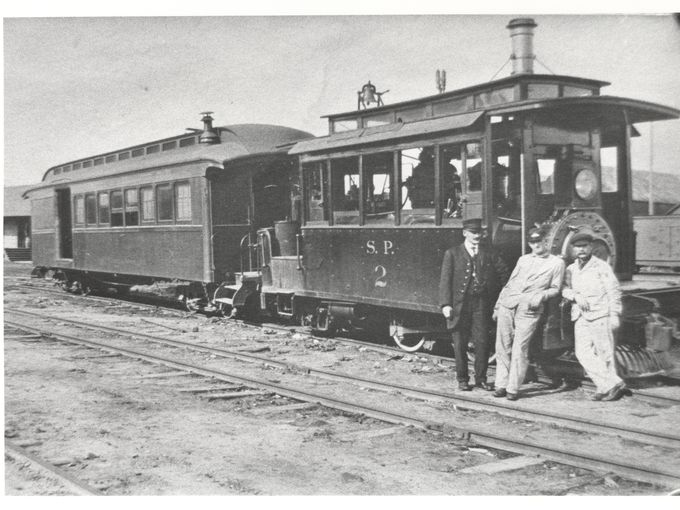
The early train rides were not equipped with dining cars and were basic in their accommodations, forcing all levels of society together - something had to change.

Next time - Improvements on the Rails
__________________________________
On this Day in Pioneer History:  "On May 21, 1881, in Washington, D.C., humanitarians Clara Barton and Adolphus Solomons found the American National Red Cross, an organization established to provide humanitarian aid to victims of wars and natural disasters in congruence with the International Red Cross.