Showing posts with label early railroad history. Show all posts

Thursday, October 15, 2020

The Quick Lunch


Rail travel in the days before dining cars, did not allow meals or upper class dining on board.  The "quick lunch" was the acceptable way Americans were fed.  The train would stop at stations  (like the B & O station on the right) and passengers were given 15-20 minutes to consume food.  The cuisine consisted of pies, patties, cakes, hard-boiled eggs, hams, and custard along with other quick food (fast food for us!).  Once the bell for departure was rung, passengers had to be onboard and seated or left behind.

The "lunch counter," a part of American culture with its quick service and uncomfortable seating (to discourage lingering over a meal) was a by-product of the railroad's quick lunch.  The first recorded use of "lunch counter" was in the New York Times on June 10, 1857 where they complained how shameful it was to use words like "Refreshment Saloon" to describe places for eating and drinking at railroad stations.

These Refreshment Saloons were long, dismal rooms where 300-400 people would rush in to grab food during a train stop.  Passengers were awaken with the conductor yelling, "Fifteen for breakfast" with no time to wash up, and no facilities to do so in.  There was just enough time to get food, eat it and get back before the train departed again.  There were few comfortable meals or washing facilities to be found along the railroad routes in America.  

In 1863 one man had a vision to change dining on trains in America...next time.

___________________________

Today in Pioneer History: "On October 15, 1863, the U.S Hunley, the first successful combat submarine, sinks during a test run killing its inventor and seven crew members.  The 40-foot submarine was developed from a cylinder boiler by Horace Lawson Hunley and operated with a crew of eight.  The final test was in Charleston Harbor in front of spectators where Hunley and his entire crew perished."

Monday, October 5, 2020

Building for the Future - or Not

 American technology was a for a land of the future, but Americans seldom thought they were building for that future.  They viewed technology in present-tense.  The British were the ones who build for the future, but not Americans.  They built for the present.


Americans were too worried about making a little capital go a long way - both monetarily and in regards to distance.  There was little thought to durability.  It was about how to get there as fast as possible rather than building for their grandchildren.  It was better to extend the system of railroads as far as possible at once and be satisfied with that initial construction, than to postpone the benefits of better quality in the future.

Building rapidly and in a flimsy way, were uniquely American practices.  Americans refused to be "beholden" to the future.  The techniques of railroad building would change they knew, just as everything in America changed.  These railroads were not the final improvement in rail travel.  

In the years to come, travel would indeed change most radically, from horses and the "iron horse" to the personal automobile.  Finally travel would take to the skies, making railroads almost obsolete in a 100 years.  Until then traveling by rail developed a society all its own...

Next time...the "class system" of the passenger rails

_________________________________________

Today in Pioneer History: "On October 5, 1892, the notorious Dalton Gang attempts a daring daylight robbery of two Coffeyville, Kansas banks at the same time.  After nearly 18 months of terrorizing the town, nearly all of the gang were killed by the quick-thinking townspeople. In the end, four townspeople were dead and only Emmett Dalton was left of the infamous Dalton Gang.

Monday, September 21, 2020

Shoddy Early Rail Construction

Early on,  American railroads were constructed in the quickest way, with little regard to safety, comfort or durability. Single tracks, steeper grades and sharper curves - no time to level inclines, cut tunnels or build up embankments.   America experimented with cheaper and quicker ways of laying tracks - with narrow gauges, wooden trestles in place of earthen or stone embankments, unballasted roadbeds and every kind of substitute material and short-cut methods.  

By mid-century American railroad wrecks due to flimsy construction and speed, over poorly constructed tracks caused numerous accidents.  The poorly graded sharp curves and unfenced track in rough terrain were the cause of western railroad mishaps as notorious as steamboat explosions in previous decades.  The need for speed driving people to get there faster was costing lives.

In 1842, Charles Dickens, who was not a man easily shocked, on his first American railway ride on the Boston and Lowell line, found it a terrifying experience.  Charles Richard Weld recorded his experience in 1855 on a train out of Cumberland, West Virginia bound for Washington, DC.  Departing late, the train was determined to make up time by increasing its speed.  Weld records his train car swaying around sharp curves to the point of having to hang on to the seat in front of him, and having a glass lamp fall from over his head.  

A fellow passenger who was experienced in railroad accidents, began to instruct him on how to prepare for a crash.  Weld, along with three ladies,  moved to the last car as that was said to be the safest car. After the crash did indeed happen, that move was credited with the reason they survived.  When Weld crawled from the wreckage, all the cars except half of the middle car and the engine were destroyed.  

Surprisingly, only Weld was willing to file a formal complaint against the conductor for excessive speed and reckless regard for passengers.  Most of those who survived were praising the conductor's efforts to get them to their destination on time!  

Next time...More on rail accidents

_______________________________

Today in Pioneer History: "On September 21, 1938, without warning a powerful Category 3 hurricane slams into Long Island and southern New England, causing 600 deaths and devastating coastal cities and town.  Called the Long Island Express, the great New England hurricane of 1938 was the most destructive storm to strike the region in the 20th century.  It was expected to make landfall in southern Florida, but the storm suddenly changed direction and began moving northward parallel to the eastern seaboard, coming ashore two days later in New York.


Thursday, May 24, 2018

Luxury and Danger on the Iron Horse

In the 1870s and early 1880s, an English born restaurateur, Frederick Henry Harvey, opened a chain of depot restaurants along the Santa Fe line that served good food at moderate prices.  He upgraded his restaurants by adding attractive, young waitresses to his staff thus providing the frontier with a sense of class.  The "Harvey Girls" were the stuff of which poetry was written as one said, "She was winsome, she was neat, she was gloriously sweet and she certainly was very good to me."

Meanwhile inside the trains, George Pullman who had introduced the folding upper berths, thought that his Pullman Palace Car Company could change the travel experience for first class passengers.  With elegant dining cars and luxury parlor cars, the wealthy could never leave the train.  Using burnished walnut, damask draperies and plush seats that converted into beds, passengers could travel in style.  Menus for a holiday meal were 12 courses - oysters, lobster, roast game, and plum pudding, along with vintage French wine with each course.  Pullman was a study in Victorian excess.

Along with the luxuries came a few annoyances and even danger.  Constant dust from the road caused ladies to wear linen dusters over their dresses for protection.  At times cowboys invaded the sanctuary of first class to fire off a few rounds, spreading panic among the passengers.  Professional card sharks in the parlor cars used their skills to relieve the wealthy of their cash as one, George Devol, reportedly took passengers for over $2 million in card games.

More dangerous than these annoyances was the unpredictable weather on the plains.  Violent spring storms washed away tracks and bridges, while blizzards caused trains to stop altogether in the middle of nowhere, miles from civilization.  In 1875 a Denver-bound train ran into such a blizzard and it was 11 days before they could reach their destination.  With temperatures below freezing and food reduced to a few cans of oysters aboard, it was a danger not too uncommon for travelers of the rails.

The transcontinental railroad - along with the luxury and danger - the "iron horse"  would settle the West.

Next time...the new settlers
_________________________________
Today in Pioneer History:  "On May 24, 1844, in a demonstration witnessed by members of Congress, American inventor Samuel F.B. Morse dispatches a telegraph message from the U.S. Capitol to Alfred Vail at a railroad station in Baltimore. The message–“What Hath God Wrought?”–was telegraphed back to the Capitol a moment later by Vail.

Monday, May 21, 2018

All Aboard!

Prior to the railroad, travel to the west was arduous by ox and wagon, or if wealthy, by a bruising stagecoach ride taking weeks and months.  Less than a week after the ceremony at Utah on May 10, 1869, the trains were scheduled to run - one westbound from Omaha and one eastbound from Sacramento - every single day.

Crossing the country by rails was an adventure vacation-like for the rich.  A first class ticket from the Atlantic Coast to the Pacific Coast via Omaha to Sacramento and then by steamboat to San Francisco cost $175,  For another $2 a night, sleeping car accommodations were added and for another $4 a day, a passenger on the once-a-week Pacific Hotel Express could receive their meals on board the train, instead of jumping off the train at roadside stops.

By 1885, three more major railroads were completed - the Southern Pacific, the Northern Pacific, and the Atchison, Topeka and Santa Fe.   These rail lines linked the entire Mississippi Valley with the Pacific Coast.  Once the plains were settled by the 1870s and 1880s, the major traffic on the rails changed...it became short distance journeys rather than the coast to coast adventures.  Cowhands, miner, farmers, schoolteachers, and hunters neither needed nor could afford the luxury prices of first class.  They just needed to get from one town to the next.  The bare bones cars with insufficient heat were greatly different from those in first class.

Those riding first class seldom thought well of those day riders, "They are not elegant, but bearded and mustached individuals, dressed in ragged garments, carrying dirty bundles, with revolvers in their belts" as one first class rider recorded.  Both kinds of passengers were forced to mingle at the track side eateries that sprang up along the track before dining cars were standard features on long distance trains.  Dudes and miners, society matrons and cowhands, all had to vie for attention just to get a cup of lukewarm coffee and half cooked piece of meat.  Food was grabbed and eaten standing up before having to hurry back to the train before it left without them.

The early train rides were not equipped with dining cars and were basic in their accommodations, forcing all levels of society together - something had to change.

Next time - Improvements on the Rails
__________________________________
On this Day in Pioneer History:  "On May 21, 1881, in Washington, D.C., humanitarians Clara Barton and Adolphus Solomons found the American National Red Cross, an organization established to provide humanitarian aid to victims of wars and natural disasters in congruence with the International Red Cross.

Thursday, May 10, 2018

Who Wants to Work on That?

Charles Crocker, former dry-goods merchant, was an outspoken, in-your-face kind of guy, and President of the Central Pacific Railroad.  A practical man, he was a hands-on president who didn't take to budget and plans of the financial side of things.  He wanted to be in the thick of the construction action, sharing in the dangers of rock slides, avalanches, and below-zero temperatures that killed many a worker.  Crocker acted like a field marshal, rally troops, plotting strategies and supervising the battles against the elements.

Crocker's biggest problem was the lack of labor.  With the lure of silver and gold in Nevada, why would any man endure back-breaking work for $35 a month when across the mountain fortunes were to be had for less work?  So workers stayed just long enough to get a free ride to the head of the line before taking off across the Sierras to Nevada.

Once the construction reached the Sierra mountains themselves, the dangerous and difficult work was more demanding and the Irishmen, who made up most of the labor force, refused to continue.  Crocker decided that California's Chinese population would be a perfect solution to his problem since they lived in shantytowns as servants, laundymen, and peddlers. 

In early 1865, Crocker's construction boss, James Strobridge, was authorized to hire these men.  He refused, stating that the white workers would walk off the job in force and refuse to work with the Chinese.  He also didn't think the physically smaller Asians could do the job of breaking granite, blasting through the wooded areas, or laying rails and spikes.  Crocker argued that the ancestors of these men had built the Great Wall of China for Heaven's sake!  At that Strobridge relented.

Next time...The Experiment
___________________________
Today in Pioneer History: "On May 10,  1869,  the presidents of the Union Pacific and Central Pacific railroads meet in Promontory, Utah, and drive a ceremonial last spike into a rail line that connects their railroads. This made transcontinental railroad travel possible for the first time in U.S. history. 

Monday, April 30, 2018

Building a Railroad

Grenville Dodge took the position of chief engineer of the Union Pacific in 1866 totally aware of the troubles ahead.  The railroad was still basically a pipe dream, with only 100 miles of track laid west of Omaha.  No sure route was even known and problems like recruiting labor, transporting supplies, holding the Indians at a distance, even finding the lumber for building were just becoming known.

The track was to be laid under the supervision of two brothers, John ("Jack") and Daniel Casement.  They made good overseers, tough and resourceful and they had the full support of Dodge.  Dan searched the country for labor and supplies, while Jack supervised hundreds of Irish, Civil War veterans, and former slaves who were doing the actual building.  Although Jack was a physically small man, he became a ruthless driver of the human machine that built the railroad.

The Union Pacific was in danger of losing its government support unless 100 miles was completed by July 1866.  With Dodge at the head and the Casement brother driving the operation, construction began to proceed at amazing efficiency.  Several hundred miles west of the workers, surveyors were mapping out the precise route to follow.  Beyond that, the grading crews with their picks and shovels (as well as rifles against the Indians), were preparing the route chosen.  Then came the actual track layers, the iron men - all of them advancing the line westward rail by rail.

As the railroad advanced into the open plains, the hardwood for the ties became impossible to find.  Soft cottonwood had to be treated with chemicals to improve its durability until the rails moved back into mountain country and hardwood was once again available.  Following the railroad ties, the iron rails were laid.  Each rail required five men to lift each rail, another group to place it across the ties and then "spikers" to drive the spikes into place. 

The workers labored labored in all weather, in all seasons for the completion of the Union Pacific.  By the end of 1866, 265 miles were laid and by December, the railroad was near Nebraska's western border, and the team of Dodge and Casement was thought to accomplish miracles.

Next time...a real threat to progress
__________________________________
Today in Pioneer History: "On April 30, 1789  George Washington, the great military leader of the American Revolution, is inaugurated as the first president of the United States in New York City.

Thursday, April 26, 2018

Western Railroad Monopoly

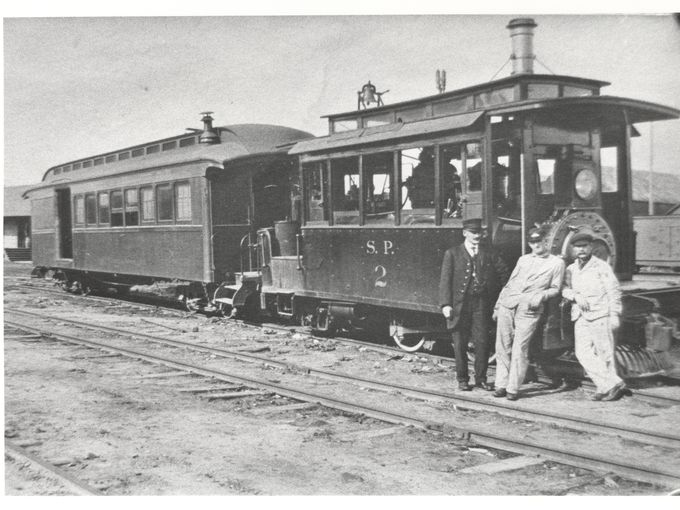
The route through the Sierra Nevada was built by Charles Crocker's "coolies and whites", but even by then the partners had bigger plans.  By 1868 they had acquired the Southern Pacific Railroad Company for a rail and shipping monopoly on the West Coast.  The two railroads met in Promontory, Utah in 1869.  The tracks extended around the San Francisco Bay area, through the San Joaquin Valley with the "Big Four" building their own lines and buying up smaller railroads until all rail traffic in California belonged to them.

The Southern Pacific reached eastward, building and buying lines in Arizona, Texas, and Louisiana, reaching New Orleans in 1883.  By 1885 they had became the "Big Three" when Hopkins died in 1878, and they merged the Southern and Central Pacific Railroads.  Another railroad, the Atchison, Topeka and Santa Fe, reached the Pacific Ocean as well, but had to pay to run its trains on the tracks of the Southern Pacific.

The Southern Pacific opened southern California to settlers, provided services to lumbermen, wheat farmers, ranchers and farmers.  A rancher in the San Joaquin Valley said of the railroad when asked how he improved his cattle, "I crossed them on a Southern Pacific locomotive." 

Many did not think the intentions of the Southern Pacific all that good...they complained loudly of ruthless business practices and monopoly freight rates charged by Huntington and his associates. 
San Francisco newspapers constantly criticized the "Big Three" for their iron rule over business and politics in California.

Huntington died in 1900, the last of the "Big Four" to do so.  He remained defiant to the last that what he and his partners did was good for the people.

Next time...The Union Pacific
______________________________________
Today in Pioneer History:  "On April 26, 1798, James Beckwourth, one of only a handful of early mountain men to emerge from the system of slavery, is born in Fredericksburg, Va. In 1824, he joined William Ashley’s third and most arduous fur-trapping expedition to the Rocky Mountains. Beckwourth received a crash course in the dangers of mountain life, just barely managing to avoid death by freezing, starvation, and Indian attacks. Despite the risks, Beckwourth enjoyed being a mountain man, and he spent the next several years as a free trapper.

Monday, April 9, 2018

An Engineering Visionary

By 1860 young engineer, Theodore Judah, had solved the problem debated for so long in Congress of how to get the railroad through the Sierras by way of the Donner Pass.  He envisioned a route with several tunnels through the mountains.

Born in Bridgeport, Connecticut in 1826, Theodore Dehone Judah was the son of Rev. Henry Judah, pastor of St. Paul's Church in Troy, New York where the family moved when Theodore was just seven years old.  He was a withdrawn boy and at 11 years old was enrolled in Rensselear Polytechnic Institute in 1837.  A professor there by the name of Amos Eaton was an early railroad enthusiast at a time most people thought the railroad was just a silly fad.  Judah was strongly influenced by the professor in his career.

Judah left college after two years to become a surveyor's assistant on the railroad where he honed his engineering skills.  While working on a job in Massachusetts, he met the daughter of the wealthy John J. Pierce.  Anna and Theodore were married in 1847 and moved to the Niagara Falls area of New York where he worked as an engineer for the Buffalo and New York railroad line. 

Judah became a enthusiast  of a rail line to the Pacific even before he moved to California in 1854 where he was to build the Sacramento Valley Railroad.  There Judah become obsessed with the Sierra Nevada and began his study on how to build a transcontinental route to the East.

When he found the answer he and his investors - Leland Stanford, Charles Crocker, Mark Hopkins, and Collis Huntington, known as the Big Four - organized plans for the Central Pacific Railroad.   Judah avoided mention of a transcontinental railroad but he did point out the profits to be had from a railroad through the Donner Pass to Nevada mining camps.  In 1861, the Central Pacific Railroad Company was founded with Judah as chief engineer. 

After a trip via the Panama Railroad back to Washington, DC to lobby for government aid for his railroad, Judah died of yellow fever in 1863 with his railroad only in its infancy.

Next time...Building across America
________________________________
Today in Pioneer History:  "On April 9, 1859,  a 23-year-old  Missouri youth named Samuel Langhorne Clemens receives his steamboat pilot’s license. During his time as a pilot, he picked up the term “Mark Twain,” a boatman’s call noting that the river was only two fathoms deep, the minimum depth for safe navigation. When Clemens returned to writing in 1861, working for the Virginia City Territorial Enterprise, he wrote a humorous travel letter signed by “Mark Twain” and continued to use the pseudonym for nearly 50 years.